
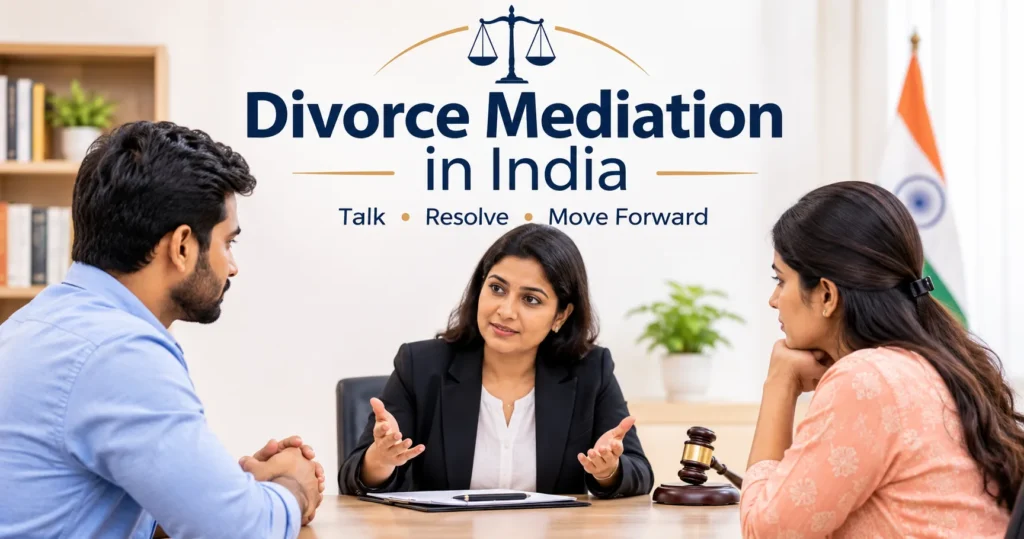
A divorce is a big step, and the law tries to provide every possible way to allow the couple to rethink the decision thoroughly and also settle other related disputes through divorce mediation.
At this stage, the parties discuss their differences, explore whether reconciliation is possible, find a middle ground for financial and custody-related issues, and also understand what changes they are accepting with the divorce.
Divorce mediation in India is the step where the parties are free to communicate and settle, while the mediator helps them reach a mutual agreement.
So, how does divorce mediation work in India? Let’s explore its process, stages, costs, legal rights, and what happens when spouses cannot reach an agreement.
Divorce mediation is a voluntary, non-adversarial dispute resolution process where a neutral mediator helps separating spouses negotiate mutually acceptable terms for ending their marriage or living apart.
In Indian family law, mediation serves as a key form of Alternative Dispute Resolution (ADR). It applies across various stages of marital discord:
Understanding where your case fits within broader divorce case types helps clarify whether mediation is the right path for your situation.
Both can help couples deal with marital issues, but in different ways. Counselling focuses on the relationship, while mediation focuses on resolving disputes and finding practical solutions.
Basis | Divorce Mediation | Divorce Counselling |
Focus | Resolving disputes and reaching agreements. | Understanding emotions and relationship issues. |
Professional | Trained mediator. | Counsellor or therapist. |
Outcome | May lead to a settlement. | May help couples reconcile or cope with separation. |
Not quite! Marital mediation focuses on resolving conflicts within a marriage, while divorce mediation helps couples settle matters related to separation or divorce. Both aim to improve communication and find common ground.
Basis | Marital Mediation | Divorce Mediation |
Purpose | Resolve marital conflicts. | Settle separation-related disputes. |
Key discussions | Communication, responsibilities, and relationship concerns. | Alimony, property, finances, and child custody. |
Desired outcome | Find a way to move forward together. | Reach a mutually acceptable separation settlement. |
The major role of a divorce mediator is to help the spouses communicate, discuss their differences, and explore possible solutions.
A lawyer, retired judge, or another qualified mediation professional can become a divorce mediator in India.
Key Responsibilities of a Divorce Mediator:
Important to Know: While a judge issues a binding ruling, the mediator does not take sides, offer legal representation, or force a decision. Instead, they facilitate constructive dialogue so both partners can identify issues, reduce conflict, and reach a voluntary settlement.
The mediation process follows a clear, structured series of stages designed to take couples from conflict to a practical agreement.
Mediation begins in one of two ways:
The mediator conducts an initial joint session to explain the ground rules, confidentiality protections, the voluntary nature of the process, and overall objectives.
Both spouses list their core concerns. The mediator helps prioritize key topics such as spousal maintenance, child custody schedules, asset division, and household debt distribution.
Through joint discussions and private individual caucuses (separate meetings with each spouse), the mediator helps the parties explore flexible compromises and evaluate realistic settlement options.
Once consensus is reached, the mediator records the exact terms in a detailed Settlement Agreement. Both spouses review the document carefully alongside their independent legal counsel before signing.
The signed agreement is submitted to the Family Court. The judge reviews the terms, confirms voluntary consent, and passes an order or decree reflecting the settlement terms.
Under Section 89 of the Code of Civil Procedure (CPC), 1908, along with Section 9 of the Family Courts Act, 1984, Indian courts have a statutory duty to attempt reconciliation or settlement through ADR before proceeding with a formal trial.
Understanding how court-annexed ADR integrates into the overall divorce law process helps couples navigate court directives without fear of losing their legal standing.
Mediation allows couples to address virtually all financial, parental, and logistical aspects of marital separation in a single forum.
Understanding financial mediation in divorce involves settling clear financial responsibilities:
Once the terms are mutually acceptable between the parties, the parties can file for divorce.
Understanding how mediation compares to other legal channels clarifies why it is often the preferred starting point:
Feature | Divorce Mediation | Court Litigation | Arbitration |
Decision Maker | The Spouses (Mutually) | Family Court Judge | Neutral Arbitrator |
Process Control | High, voluntary terms | Low, dictated by court rules | Medium, structured procedural rules |
Formality | Informal, conversational | Formal, strict rules of evidence | Semi-formal proceeding |
Duration | Weeks to a few months | Months to several years | Months to a year |
Final Outcome | Voluntary Settlement Agreement | Judicial Decree/Judgment | Arbitral Award (Not valid for divorce decree) |
Note: In India, arbitration cannot grant a formal decree of divorce, as matrimonial status is a matter of public law that requires a judicial decree.
The key benefits of divorce mediation are:
Mediation expenses depend on whether you use court-annexed facilities or private mediation professionals.
Court-referred mediation at Family Court centers is provided as a public service. It is free of charge or involves nominal administrative fees, making it accessible to all litigants.
Private mediators charge hourly or per-session fees depending on their seniority, experience, and city location:
In most cases, spouses split the mediation costs equally, though parties can negotiate different payment arrangements in their final agreement.
If you understand how divorce mediation works, you understand that this timeline can sometimes end within 2-3 sessions and sometimes stretch to several months as well, depending on how the parties come to an agreement and if the mediator is able to help them. But this is surely shorter than divorce proceedings in a court.
Timelines depend on how quickly spouses submit financial records, their willingness to compromise, and the complexity of child custody or asset division terms.
A common point of confusion is whether a signed mediation paper automatically ends a marriage.
Legal Rule: A mediation agreement is a legally binding contract between spouses, but it does not automatically dissolve a marriage.
For a complete breakdown of asset valuation, alimony structures, and settlement drafting rules, read our dedicated guide on reaching a fair divorce settlement.
While mediation is highly effective, it requires a safe and equitable environment to succeed.
Mediation May Be Suitable | Mediation May Require Caution |
Both spouses are willing to communicate. | There is ongoing domestic violence, intimidation, or fear. |
Both parties are open to honest financial disclosure. | One spouse is hiding assets or withholding financial information. |
Both share a genuine concern for their children’s welfare. | There is a serious power imbalance or pressure to accept unfair terms. |
Both are willing to negotiate and consider reasonable solutions. | One spouse is unwilling to participate freely or negotiate in good faith. |
If a relationship involves active domestic abuse, coercion, or severe mental health instability, traditional court representation with protective orders is necessary to safeguard individual rights.
If spouses cannot reach an agreement, the mediation is closed as “unsuccessful.”
Proper preparation ensures you enter negotiations feeling confident and organized:
If you are not sure or want to present your matter on more legal grounds with expert support, you can also consider consulting with a divorce lawyer in India.
Divorce mediation in India gives couples an opportunity to reconsider their decision, explore reconciliation, or work towards a mutually acceptable separation. With the help of an unbiased mediator, spouses can discuss their differences and find common ground on important matters such as alimony, property, finances, and child custody.
It offers a more collaborative way to address these concerns while keeping both parties involved in the decisions.
If you are considering divorce mediation, understanding its process, costs, legal implications, and limitations can help you decide whether it is right for your situation. Mediation may not resolve every dispute or save every marriage, but it can help make difficult decisions more thoughtful, informed, and less stressful.
No, divorce mediation is not compulsory in every case in India. A family court may refer spouses to mediation under the applicable legal framework, including Section 89 of the Code of Civil Procedure, 1908, where settlement appears possible.
However, mediation is voluntary, and neither spouse can be forced to agree to a settlement. The court may encourage parties to explore mediation, but the final decision must remain theirs.
Yes. A spouse can decline to participate in mediation or choose to withdraw from the process. Since mediation depends on voluntary cooperation, it cannot force either person to negotiate or accept an agreement.
If divorce mediation does not proceed, the mediator generally informs the referring court, and the divorce case can continue through the appropriate legal process.
Yes. Divorce mediation can take place online in India, subject to the rules and arrangements of the mediation center or the mediator. Video conferencing can help spouses participate when they live in different cities or countries or cannot attend in person.
However, both parties should have a private and secure setting to discuss sensitive matters freely. The mediator must also ensure that each spouse can participate meaningfully.
Spouses can reach a partial settlement during divorce mediation. For example, they may agree on child visitation and education expenses but remain unable to settle maintenance or property-related disputes.
The agreed terms can be recorded, while unresolved issues may require further negotiation or a decision by the court. A partial settlement can help narrow the dispute, even when the couple cannot resolve every matter.
Financial disclosure is important because a fair settlement depends on accurate information about both spouses’ financial positions. If someone hides income, property, investments, debts, or other material financial details, the other spouse may agree to terms without understanding the complete picture.
Before signing a settlement, both parties should review relevant financial documents and seek independent legal advice. If deliberate concealment is discovered later, it may provide grounds to question the settlement, depending on the facts and applicable law.
No. A divorce mediation settlement must reflect the parties’ free and informed consent. Neither a mediator nor the other spouse should pressure someone into accepting terms they do not understand or agree with.
Each person should have enough time to review the proposed agreement, understand its legal and financial effects, and seek independent legal advice. If there is intimidation, coercion, or an unfair power imbalance, the mediator should address the concern and assess whether mediation can continue safely.
Child-related decisions should focus on the child’s safety, welfare, and overall development, rather than simply dividing custody between parents. Parents can discuss living arrangements, visitation schedules, school fees, healthcare, holidays, and communication with each parent.
They can also agree on how to handle important decisions as the child grows. Any proposed arrangement must serve the child’s best interests, and the court retains the authority to assess it under the applicable law.
Yes. A spouse living abroad may be able to participate in divorce mediation through online sessions, depending on the mediator’s arrangements and applicable court procedures. This can make it easier for couples dealing with long-distance separation or NRI divorce matters to discuss settlement terms without travelling for every session.
However, any agreement must still meet the relevant legal requirements in India, and further court appearances or formalities may be necessary.
No. A divorce mediator does not necessarily have to be a lawyer. Mediators may come from different professional backgrounds, including law, psychology, social work, and dispute resolution.
What matters is their relevant mediation training, competence, neutrality, and ability to manage sensitive family disputes. A mediator helps spouses communicate and explore settlement options but does not replace independent legal advice from each party’s lawyer.

Advocate Priya Paul, a proactive Delhi-based lawyer, leads a skilled team and shares legal insights through her blog to help readers navigate the law.
Have Any Questions?
As per the Bar Council of India’s rules, advocates are not allowed to advertise or solicit clients, and this site is intended solely for information sharing.
By clicking the button “I Agree,” you accept that:
If you wish to get additional information, please feel free to connect with Advocate Priya Paul at 9560744478 or advocatepriyapaul25@gmail.com