
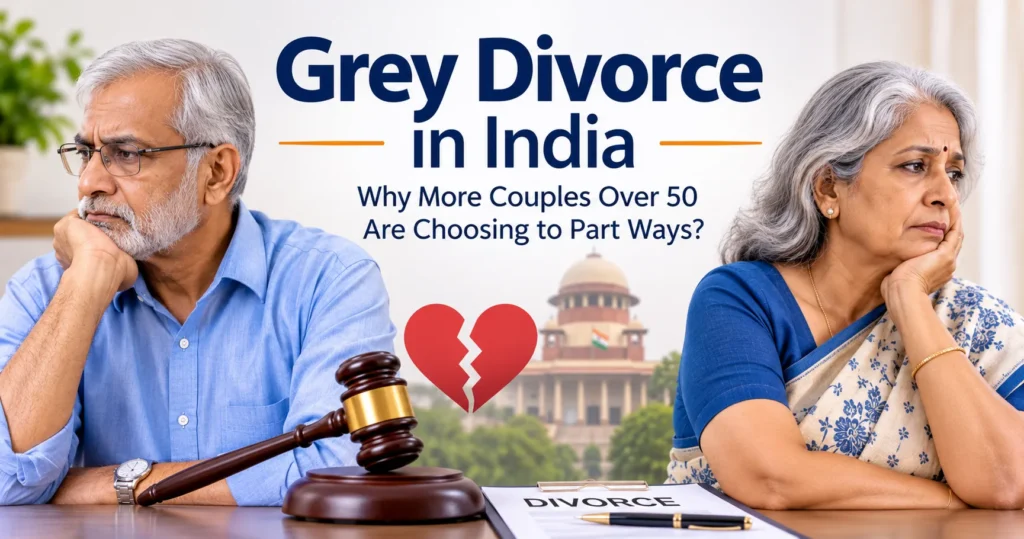
The older generation often tells younger generations that marriages are sacred and supposed to last a lifetime. But as much as marriage is sacred, history has proved that some are supposed to end at some point rather than making sacrificial amendments.
And now these reasons are clearly acceptable to our senior generation. They are accepting separation and even choosing divorce at a later stage of their life. That’s what grey divorce is. Divorcing couples who end their marriage after 50 years of age (not the marriage period) are grey divorce couples in India.
This phenomenon has been emerging in the past few years for many reasons. These include elderly couples who were forced to continue the marriage for the sake of society and children, couples who were so involved in responsibilities that they never realized their compatibility as husband and wife, or couples who are now free from many social pressures and wish to live their lives.
There can be multiple reasons why the number of grey divorces in India is increasing, but the interest in living life is the same. And most of the time, because of the maturity and bond that became stronger with time as the couple faced challenges and happy times together, this ends up in a mutual discussion and understanding without any dispute, as we see in young couple divorce cases.
In this blog, we will go through the meaning, the reason, the legal grounds and status, the precedents, and more related to grey divorces in India.
Grey divorce, also known as grey divorce, silver divorce, or late-life divorce, refers to the separation or divorce of couples where at least one spouse is aged 50 or older. It often involves marriages that have lasted for 20, 30, or even 40 years.
The term describes a social and demographic trend, not a separate legal category. In India, grey divorce is governed by the matrimonial laws applicable to the couple, just like other divorce cases.
Understanding Grey Divorce | |
Key Aspect | What It Means |
50+ Age Threshold | At least one spouse is generally aged 50 or older. |
20–40 Years of Marriage | Often follows decades of married life, though this is not a requirement. |
Social Term, Not a Legal Category | Grey divorce is governed by the matrimonial laws applicable to the couple in India. |
Remember: The age of the spouses defines the commonly used term, not the number of years they have been married. A couple does not need to complete 20 or more years of marriage for their divorce to be described as grey divorce.
There is rarely a single reason why a long marriage ends. Sometimes, unspoken issues build over decades; in other cases, major life transitions, such as retirement or an empty nest, bring underlying incompatibilities into sharp focus.
Over decades, unresolved disputes, growing emotional distance, and a complete lack of companionship can turn a household into a quiet, shared living arrangement rather than a fulfilling partnership. When communication breaks down completely, staying together simply out of habit loses its appeal.
Historically, many spouses, particularly women, remained in unhappy or oppressive marriages due to total financial dependence. Today, increased financial independence among women, growing social awareness, and a lower tolerance for emotional neglect mean older adults are less willing to spend their remaining decades in an unhappy relationship.
For many couples, raising children serves as the primary anchor holding the marriage together. Once adult children finish their education, secure jobs, or move out to start their own lives, parents are left alone together. Without the shared focus of daily parenting, existing marital flaws become impossible to ignore.
Retirement brings a dramatic shift in routine. Spending 24 hours a day together can expose big differences in lifestyle expectations, hobbies, and personal goals. One spouse may dream of quiet travel, while the other wants to remain active in work or social projects, leading to irreconcilable friction.
Physical or domestic abuse, extramarital affairs, substance misuse, or severe financial misconduct do not disappear with age. In many cases, spouses endure abusive dynamics for years for the sake of their children and decide to seek a divorce only after reaching financial or personal milestones later in life.
India has no official national statistics tracking grey divorce among people aged 50+. While exact growth figures are unavailable, reports and research indicate rising visibility of later-life separations.
Key figures: 50+ years is the commonly used age threshold. The 1990–2010 US data showed the grey divorce rate doubling from approximately 5 to 10 per 1,000 married adults aged 50+. This is international data, not an India-specific trend.
Region | Statistical & Social Observations |
United States | Research by the Pew Research Center indicates that the grey divorce rate among adults aged 50 and older roughly doubled between 1990 and 2010. |
India (Urban Trends) | While national census records do not break down divorces by age group, Family Court filings in cities like Delhi, Mumbai, Bengaluru, and Kolkata reflect a steady rise in petitions filed after 25+ years of marriage. |
Academic & Sociological Insights | Indian sociological studies highlight that extended lifespans, shifting family structures, and urban financial self-reliance contribute significantly to grey divorce in India. |
Divorcing in your 50s or 60s presents structural, financial, and emotional differences compared to ending a marriage in your 20s or 30s.
Factor | Divorce at a Younger Age | Grey Divorce (50+) |
Marriage Duration | Typically shorter (1 to 10 years) | Long-term (20 to 40+ years) |
Child Custody | Primary focus on minor child custody & visitation | Children are adult dependents; focus shifts to family relationships |
Financial Recovery Time | Decades available to rebuild career & wealth | Limited time to recover lost savings before retirement |
Asset Base | Fewer accumulated shared assets | Complex asset pool: homes, investments, pensions, inheritances |
Healthcare Considerations | Health expenses are generally predictable | Immediate concern with medical coverage, insurance, and long-term care |
Any individual over the age of 50 or 60 holds the exact same constitutional and statutory right to seek a divorce as a younger person. Age or marriage duration does not restrict access to family court remedies.
Applicable Matrimonial Laws in India | |
Legislation | Who It Applies To |
Hindu Marriage Act, 1955 | Hindus, Buddhists, Jains, and Sikhs. |
Special Marriage Act, 1954 | Couples married under the civil marriage framework, including interfaith couples. |
Christian Personal Law | Christian marriages, primarily governed by the Indian Divorce Act, 1869. |
Parsi Personal Law | Parsi marriages, governed by the Parsi Marriage and Divorce Act, 1936. |
Muslim Personal Law | Muslim marriages and divorce, governed by applicable personal laws and relevant legislation. |
Note: The applicable law depends on the couple’s religion, the law under which they married, and the circumstances of the case.
To file a contested divorce, an applicant must establish statutory grounds under their applicable law, such as:
Divorce types are the same for all generations as:
Working alongside an experienced divorce lawyer in Delhi or a qualified family law practitioner in your jurisdiction helps ensure your rights are properly presented in court.
Securing long-term financial maintenance is often the single most critical aspect of a late-life divorce, particularly for a spouse who spent decades managing the household without an independent income.
Yes. A wife who lacks independent financial means to support her established lifestyle can claim interim maintenance during court proceedings and permanent alimony upon final decree under Section 25 of the Hindu Marriage Act, Section 144 of the Bharatiya Nagarik Suraksha Sanhita (BNSS), 2023, or applicable civil laws.
Yes, under gender-neutral provisions. Under Sections 24 and 25 of the Hindu Marriage Act, 1955 (and Sections 36 and 37 of the Special Marriage Act, 1954), a husband can claim maintenance from his wife if he has no independent income, suffers from a severe medical disability, or was financially dependent on his wife during the marriage, and the wife is still capable of maintaining him.
Under these sections, no age for any spouse is mentioned or described, nor is the retirement part mentioned under the law; that’s why it completely depends on the circumstances.
When determining permanent alimony after a long marriage, Indian Family Courts evaluate:
To understand how courts evaluate support payments, read our detailed guide on navigating the broader divorce law process.
Property division during a grey divorce requires careful navigation because Indian law handles asset ownership differently from Western “community property” models.
Asset Type | Ownership and Legal Position |
Self-Acquired Property | Generally belongs to the person who legally owns it. |
Jointly Owned Property | Each owner’s rights depend on the ownership share and applicable legal principles. |
Inherited Property | Ownership depends on how the property was inherited, the applicable succession law, and the nature of the inheritance. |
Stridhan | Belongs exclusively to the wife, who has full ownership rights over it. |
Under Indian law, a divorce decree does not automatically split a home 50/50 simply because the couple was married for decades.
Pensions, gratuities, and Provident Fund (PF) deposits earned by an employee belong strictly to that individual under employment laws. However, when evaluating permanent alimony, courts account for the supporting spouse’s total pension payout and retirement wealth to calculate a fair monthly maintenance amount or lump-sum settlement.
Once a divorce decree becomes final, an ex-spouse can no longer remain covered under a partner’s corporate or family floater health insurance policy. Securing independent health insurance or requiring the supporting spouse to fund an individual policy is a critical component of any final settlement.
A divorce automatically invalidates spousal inheritance rights under intestate succession laws (such as the Hindu Succession Act, 1956). Following a divorce:
To learn more about structuring asset division during mutual agreements, review our comprehensive resource on reaching a fair divorce settlement.
While Indian law lacks a standalone grey divorce statute, landmark Supreme Court rulings establish key legal protections for older spouses:
If you are considering a late-life separation, systematic preparation protects your financial stability and peace of mind.
Understanding the specific legal route helps clarify how to file for divorce under your applicable personal law.
Yes. Divorce mediation is highly effective for couples ending a long-term marriage.
[Joint Mediation Sessions] ➔ [Private Financial & Housing Discussions] ➔ [Binding Settlement Agreement] |
Mediation offers a private, confidential setting where older couples can negotiate financial support, property division, and family obligations amicably without undergoing a stressful, public court trial.
If both parties reach an agreement, the mediator drafts a settlement agreement, which is submitted to the Family Court to secure a fast-track mutual consent divorce decree.
Grey divorce in India refers to couples choosing to end their marriage when at least one spouse is aged 50 or older. While there is no separate law for grey divorce, the same matrimonial laws and legal remedies apply. From maintenance and alimony to property ownership and retirement savings, understanding these rights is essential before making such an important decision.
A long marriage does not mean anyone has to spend the rest of their life in an unhappy relationship. With the right legal guidance, financial planning, and a clear understanding of available options, couples can approach separation with greater confidence and dignity. The goal is not just to end a marriage but to make the next chapter of life more secure, independent, and peaceful.
Grey divorce and silver divorce generally refer to the same concept: the separation or divorce of older couples, commonly involving at least one spouse aged 50 or above. The terms are often used interchangeably, although silver divorce is sometimes used in media and social discussions to describe later-life marital separation.
No. Grey divorce is generally defined by the age of the spouses, not the duration of their marriage. It usually refers to divorce involving at least one spouse aged 50 or older. A couple may qualify even if they have been married for fewer than 20 years.
Yes. A person can file for a contested divorce without their spouse agreeing to it, provided they have a legally recognized ground under the applicable matrimonial law. However, filing a petition does not automatically result in a divorce. The court must examine the case and decide whether the legal requirements are met.
Yes. A divorced person can remarry once the divorce decree has become final and they are legally free to marry. Under Section 15 of the Hindu Marriage Act, 1955, remarriage is permitted when there is no right of appeal against the decree, the appeal period has expired without an appeal, or an appeal has been dismissed. Other matrimonial laws have their own applicable provisions.
Yes, a medical condition may be relevant to certain aspects of divorce proceedings, but it does not automatically prevent someone from seeking a divorce. A court may consider health, medical expenses, financial dependence, and the ability to participate in proceedings when deciding relevant issues. The legal effect depends on the circumstances and applicable law.
Yes, a spouse living abroad may be able to initiate divorce proceedings in India if the Indian court has jurisdiction under the applicable matrimonial law. However, jurisdiction depends on factors such as the parties’ residence, place of marriage, and other legally relevant connections. Cross-border cases may also involve questions about service of notice, participation through permitted procedures, and recognition of foreign divorce decrees.
In certain circumstances, yes. Section 144 of the Bharatiya Nagarik Suraksha Sanhita, 2023, provides for maintenance claims by eligible parents who are unable to maintain themselves and whose children have sufficient means but neglect or refuse to support them.
The Maintenance and Welfare of Parents and Senior Citizens Act, 2007, also provides a framework for eligible parents and senior citizens to seek maintenance from specified children or relatives. These rights depend on the statutory conditions and are separate from a former spouse’s maintenance obligations.
A divorced person may be able to update nominations, but the process depends on the policy, pension scheme, applicable rules, and any legal restrictions. Divorce does not automatically update every nomination or beneficiary record. It is important to review insurance policies, pension records, bank accounts, and other financial documents after the divorce becomes final.

Advocate Priya Paul, a proactive Delhi-based lawyer, leads a skilled team and shares legal insights through her blog to help readers navigate the law.
Have Any Questions?
As per the Bar Council of India’s rules, advocates are not allowed to advertise or solicit clients, and this site is intended solely for information sharing.
By clicking the button “I Agree,” you accept that:
If you wish to get additional information, please feel free to connect with Advocate Priya Paul at 9560744478 or advocatepriyapaul25@gmail.com